An Epiphany... I am a high-risk doula

This client has Nitrous Oxide ready as she uses Pitocin to nudge her labor induction along
Have you ever missed something that was right in front of you? While I was traveling to Lexington, KY, for an Evidence Based Birth® (EBB) Instructor Retreat with Dr. Rebecca Dekker, I started thinking about my clients and how much they’ve gained from the research EBB® has shared, especially regarding the various challenges that can arise during pregnancy and birth.
Many of my clients are over 35, and quite a few are over 40. I’ve supported people through complications such as cholestasis, hypertensive disorders like Gestational Hypertension and Preeclampsia, Gestational Diabetes, plus-sized pregnancies, and IVF. If any of this sounds like you and I’ve been your doula or teacher over the past 15+ years, give me a “hell yeah.” I can almost hear you all now—there are so many of you, and you make your voices heard.
I also work closely with my friend and colleague, Shalin Butterworth. She, too, is a doula and EBB Instructor, and she teaches the EBB Childbirth Class. Shalin runs a doula mentorship program that I’m part of, where I share my experience as an RN and doula. On my way to Lexington, one of her mentored doulas was facing a tough induction. Thanks to airplane WiFi and a long layover in Atlanta, I was able to join our private chat group and help this newer doula understand the pros and cons of the induction options her client was being offered.

This client was 41 years old and was induced for her 2nd birth for post dates. She went on to have an unmedicated water birth
Another doula in the mentor group who loves home births (and honestly, what doula doesn’t?) chimed in, frustrated by what this doula and client were dealing with at the hospital and stated in all caps, “This is why I hate inductions.” I can’t say I “love” them either, so I understand her point. She gets to do a lot of home births, which isn’t usually the case for me. It’s not that I wouldn’t want to, but those clients don’t usually seek me out. I think the RN after my name makes some people feel I represent the kind of care they want to avoid with an out-of-hospital birth. What they might not realize is that I was their biggest fan when I worked as an RN in the hospital. And they probably don’t know that I had a home birth myself and would do it again in a heartbeat.
I didn’t lose much sleep over her comment, because when I think about her feelings toward inductions, I also remember all the beautiful babies I’ve seen born after a well-informed induction. I feel lucky to have been part of each of those birth stories.
But if you know me, you know I strongly believe inductions should be a last resort and only done when it’s the right choice for my clients. My years as a nurse at an evidence-based hospital, working alongside midwives and doctors who consistently achieve one of the lowest cesarean rates in California, have given me a unique perspective as a doula. Inductions can be done with care and compassion. I believe that in my soul.
While you cannot plan the path your birth will take, having a backup plan for every contingency helps you feel confident in your decision-making. No one knows exactly how things will go. Not even me. I prepare my clients for every possibility, even though I hope they won’t need those plans. When they do, we’re ready. We’ve talked about it and explored what matters most. We might not like every option, and sometimes we push back, which I always support. What is my ultimate goal for every client? That I know you know everything there is to know.

This client was diagnosed with Gestational Diabetes (GDM) in her pregnancy. She was then diagnosed with Preeclampsia later in her pregnancy requiring an induction. Hypertensive disorders are more common in people with GDM. She was induced in her 37th week and went on to labor/birth without pain meds or an epidural.
I’ll admit, I love it when a client goes into labor on their own, and I get to support them at home. It does happen, but not as often as I’d like. I realized this while I was explaining Misoprostol (Cytotec)—what it’s for and when not to use it—to the new doula during her client’s surprise induction. I also helped her see why starting Pitocin so early (which they tried) might have skipped some important steps. Helping this doula support her client felt natural to me. I didn’t have a strong reaction to the induction because I’m used to it. Not because my clients aren’t informed or are pressured into something they don’t want. It’s because they understand why the recommendation was made, they’re given space and time to consider their options, and they give their consent for reasons that only matter to them. I made sure to give this doula all the information she needed to support her client and offer real options.
At first, I brushed off this other doula’s strong feelings about inductions, thinking, “She’s new, and she’ll see plenty of inductions as she keeps doing this doula thing.” But then I realized—maybe she won’t. She’s a wonderful doula and very different from me, and I respect that. Diversity is what makes each of us unique in the birth world, and we need more unicorns and fewer sheep. Maybe her disdain for inductions draws in mostly healthy clients who are great candidates for home birth, which is her specialty. As I thought back on my own clients, I realized I work with far more high-risk clients, many of whom often need inductions. I realized I’m a high-risk doula 💡 and honestly, I’m really good at it.
Why do I work with more inductions and higher-risk births?
Is it because I have RN after my name? That’s probably a big reason. I’ve heard many people say, “I liked that you’re an RN.”
Is it because I’ve been doing this for a long time? Absolutely. After more than 20 years in maternity care, I’ve seen a lot. I’ve seen more rare diagnoses, simply because I’ve been both an RN and a doula for so many years. The more experience you have, the wider your perspective.
Is it because I used to be a NICU and pediatric OR nurse? I’m sure some people notice that in my bio and value it. I’ve always geeked out in some of the most stressful professions in nursing.
Is it because I’m an EBB Instructor well-versed in current research? Hell YES! Just because we have a disease process or complication in our birth doesn’t mean we toss it over to our provider with our hands up and say, “Whatever you say, Doc”. We don’t give up advocating for ourselves just because we need medical intervention. That’s exactly when we need advocacy the most!
Is it because I was over 35 with both of my pregnancies and understand what it’s like to start a family later in life? Maybe you traveled the world, worked hard to reach your career or education goals, tried for a long time, or waited to find the right partner. I’ve been there myself, and honestly, I see you.
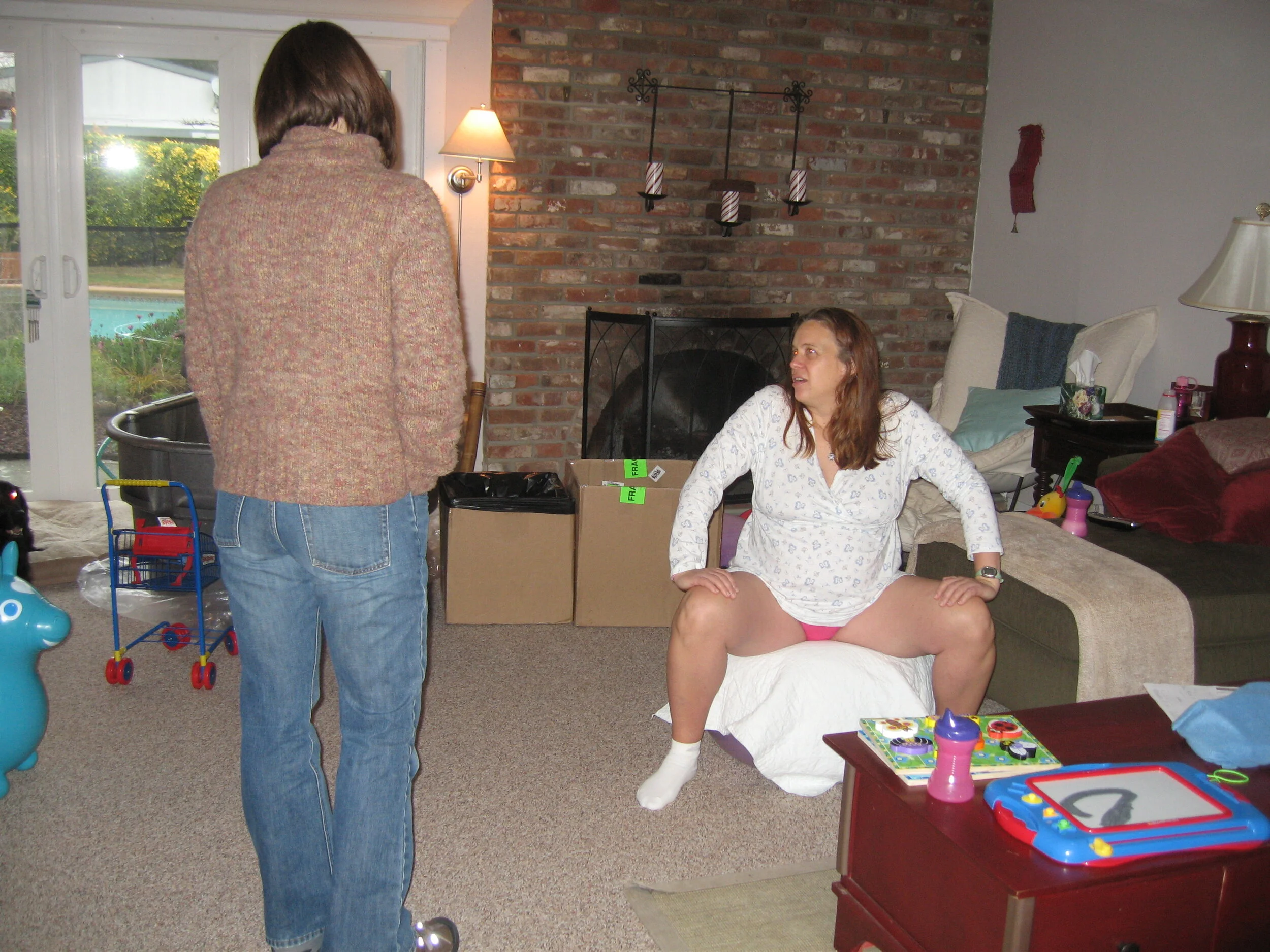
I was 39 when I had my son at home while my 22 month old daughter bounced on a trampoline and watched her “aby brother” enter this crazy world.
So what’s the big deal with being pregnant at 35 or older? EBB has a comprehensive Signature Article titled "The Evidence on Pregnancy after the Age of 35." I’ve also included the podcast below if you prefer to listen. I love guiding, supporting, and educating clients through the myriad of pregnancy/birth decisions we face after 35yo. I’ve helped many people have empowering births with this diagnosis—whether spontaneous or induced—by focusing on your values and what matters most to you. Couples in my EBB Childbirth Class learn this too, and since I teach the class fully online, I’ve helped people from all over the county feel confident in their choices.
Since clients over 35 make up a big part of my practice (45% of my doula clients in 2026), I’m very familiar with the diagnoses that often come with this age group-hypertensive disorders, infertility, history of miscarriage, VBAC, birth trauma, thyroid disease, gestational diabetes, and more. These conditions often live under a cloud of potential induction. To make informed decisions about inductions, you need to understand topics such as antenatal testing, biophysical profiles (BPP), Bishop scores, cervical ripening, stalled labors, postpartum hemorrhage, and more.

This perfect baby arrived on the scene after 41 week induction for post dates. They knew their options and chose the induction method that felt right for them. They went on to birth their baby with no medical pain relief about 24 hours after their induction began.
Diversity amongst doulas is necessary. We cannot be a jack of all trades. I know that for me, supporting home births isn’t where my skills are best utilized, even though I had one myself. 55% of my clients are under 35 but have other risk factors besides AMA. And there is a subset of that group who are completely healthy. However there are other reasons for inductions, like going past your due date or pre-labor rupture of membranes (PROM). With my first baby, checked all the boxes. I was over 35, I waited to 42 weeks for labor to begin on it’s own, and when my waters broke the night before the induction that I planned to refuse, thick meconium came out and in an instant, all my plans had to change. I was healthy, till suddenly I wasn’t.
In the EBB Childbirth Class, we look at the evidence for inducing for due dates and PROM. Many people are surprised to learn there’s more to it than they thought. Induction isn’t always the answer, and hospital policy doesn’t always fit our personal situations. I strongly believe in shared decision-making because you are the best decider for your body, your baby, and your medical condition.
Sometimes, medicine is necessary. Support and education are key advocacy tools that help us take ownership of our births. We teach these important skills in the EBB® Childbirth Class, because knowing when an induction is needed is the first step. Right now, 32% of my clients have had their labors induced. Surprised? You might have expected more, given my client base, but that’s the power of education.
If my clients didn’t know their options, that number would be much higher.
If my clients didn’t know when to ask for alternatives, that number would be much higher.
If my clients just said, “Whatever you say, doc”, that number would be much higher
When someone tells me they had a traumatic first birth and they didn’t have a doula, I often ask what made them decide against a doula. They often state that they thought doulas were only for home births. Or that doulas aren’t useful if you’re being induced or want an epidural. To that I say, “That’s EXACTLY why you’d want a doula!” Doulas can lower your chances of having a Cesarean birth by 25% compared to having partner support alone. Do I have your attention now?
With support and education, pregnancy diagnoses do not have to equal inductions.
With support and education, inductions do not have to equal cesareans.
With support and education, anything is possible.
Without support and education, no decisions are ours.
I’m an RN, a high-risk doula, and an Evidence Based Birth® Instructor. I became a mom at 37 and 39, experiencing both an induced birth and a home birth. I’m skilled at helping you understand your options and the evidence behind them, and matching those options to your values. I’m here to guide you if your low-risk pregnancy or labor suddenly becomes high-risk. I know when to step back and let a normal birth unfold. And above all, I’m a really good educator on all of it.